
Menu
Beyond Chatbots: Why the Future Belongs to Agentic Workflows
Published on December 15, 2025
Beyond Chatbots: Why the Future Belongs to Agentic Workflows
For years, businesses have depended on traditional chatbots to handle customer inquiries, answer FAQs, and provide basic support. While these systems improved response times and reduced support costs, they remained fundamentally passive. They could respond—but they could not act.
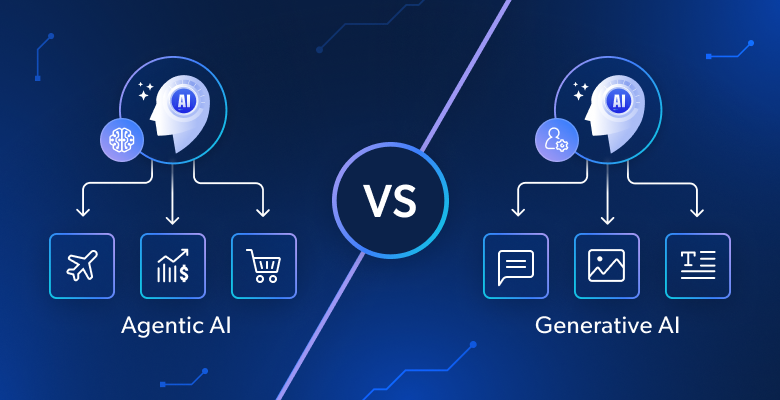
Today, we are witnessing a major paradigm shift: the rise of Agentic AI.
Unlike classic conversational AI, agentic systems are designed to take initiative, plan ahead, and execute complex workflows autonomously. This shift marks a turning point in how organizations design digital labor and scale their operations.
From Passive to Active: A New AI Paradigm
Traditional chatbots operate in a reactive mode. They wait for user input, match it against predefined rules or learned patterns, and generate a response. Their usefulness is limited to conversation.
Agentic AI, on the other hand, introduces functional intelligence:
- It understands objectives, not just questions
- It plans multi-step actions to reach a goal
- It interacts with tools, APIs, and databases
- It makes decisions within clearly defined boundaries
In short, AI agents don’t just talk about work—they do the work.
Multi-Agent Orchestration: Intelligence at Scale
One of the most powerful aspects of agentic workflows is multi-agent orchestration.
Instead of relying on a single monolithic system, organizations can deploy multiple specialized agents, each focused on a specific domain:
- Sales Agents qualify leads, update CRMs, and trigger follow-ups
- Support Agents resolve tickets, escalate issues, and track SLAs
- HR Agents screen candidates, schedule interviews, and manage onboarding
These agents collaborate, exchange context, and coordinate actions—much like human teams. The result is a system that can solve complex, cross-functional problems with speed and consistency that manual processes simply cannot match.
The ROI of Autonomy
Autonomous agents deliver significantly higher returns compared to traditional automation tools.
Why?
Because they go beyond scripted workflows. Agentic systems can adapt to changing conditions, handle exceptions, and continuously optimize their own performance. This leads to:
- Faster execution of business processes
- Reduced operational overhead
- Fewer human errors
- Better use of human talent
Instead of replacing people, autonomous agents amplify human potential by removing repetitive and operational burdens.
The Future of Work Is Agentic
As businesses scale, complexity grows. Static automation and passive chatbots are no longer enough. The future belongs to systems that can reason, act, and collaborate.
At AIME, we are leading this transition by building ecosystems where AI agents don’t just process language—they manage entire business processes. By delegating operational work to autonomous agents, organizations can free human teams to focus on creativity, strategy, and innovation.
The age of chatbots was only the beginning.
The age of agentic workflows has just begun.